
Futures
Binance Leverage Tiers: Why Max Leverage Drops as Your Position Grows
Leverage limits are set by notional brackets. Growing a position moves it into a bracket with a higher maintenance requirement — which can pull liquidation closer even as you add margin.
Maximum leverage on Binance futures is not a single number per contract. It is set by notional brackets: as your position value grows, you move into brackets that allow less leverage and require a higher maintenance margin rate.
The leverage selector is a cap, not a setting. Choosing 20× does not make the position 20×; it permits up to 20×, and only while the notional stays inside the bracket that allows it.
How the bracket system works
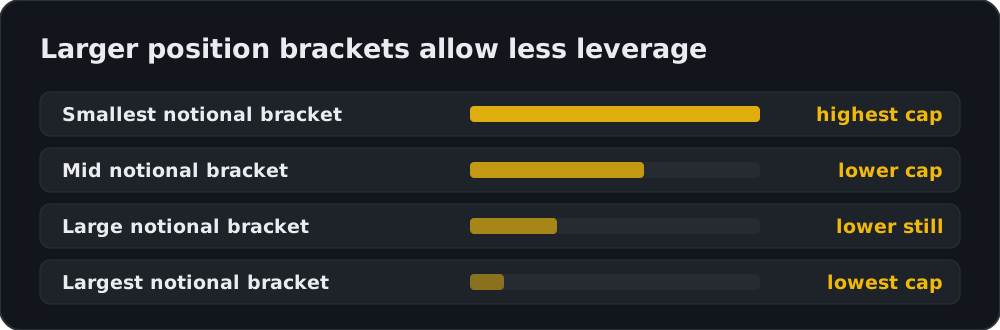
Each contract has a ladder of notional ranges. For every range the exchange publishes a maximum leverage and a maintenance margin rate. Small positions sit in the first bracket with the highest permitted leverage and the lowest maintenance rate. As notional increases, both move against you: less leverage allowed, more maintenance margin required.
The reason is straightforward risk management. A large position cannot be unwound into the order book as cleanly as a small one, so the exchange demands a thicker equity cushion behind it.
Exact bracket boundaries differ per contract and change over time. Read the current ladder on the contract's own risk-limit or leverage information screen rather than assuming one contract's ladder applies to another.
The consequence people get wrong
Here is the part that causes real damage: adding to a position can move liquidation closer, even though you added margin.
If the added notional crosses into a higher bracket, the maintenance margin rate applied to the whole position rises. The maintenance requirement — the numerator of your margin ratio — can grow by more than the margin you just contributed. The ratio goes up, and the liquidation price moves toward you.
Averaging down into a losing trade is exactly the situation where this happens, and exactly the situation where nobody checks the bracket ladder first.
Mechanically this runs through the margin ratio; see Binance margin ratio.
Why your leverage silently reduces
Two related behaviours surprise new traders:
- You cannot select high leverage on a large position. The interface caps the selector at whatever the current bracket permits.
- You may have to reduce leverage before increasing size. If the intended notional lands in a bracket whose cap is below your current setting, the size increase is blocked until leverage comes down.
Neither is an error. Both are the bracket ladder doing its job.
Planning size and leverage together
Decide the position before touching the leverage selector:
- Fix the risk budget in currency — the maximum you will lose on this trade.
- Set the stop distance from the chart, not from what leverage allows.
- Derive notional: notional ≈ risk budget ÷ stop distance %.
- Check which bracket that notional falls into, and its cap.
- Set leverage at or below that cap, sized so the liquidation price sits well beyond your stop.
Step 5 is the one that matters. If liquidation sits closer than your stop, the stop is decorative — the position gets closed by the platform first, at a worse price, plus the roughly 1.25% clearing fee detailed in Binance futures fees.
Cross margin does not remove the ladder
Under cross margin the wider balance backs the position, so liquidation sits further out. The bracket ladder still applies: maintenance requirement still scales with notional. Cross margin changes what is available to absorb the requirement, not the requirement itself.
A checklist before adding size
- Which bracket is the position in now, and where is the next boundary?
- Will the new notional cross it?
- What does the maintenance rate become on the far side?
- After adding, where does the liquidation price sit relative to my stop?
- Is my leverage setting still permitted at the new size?
Running these five questions takes under a minute and prevents the specific failure where a trader adds margin to a losing position and gets liquidated sooner than before.
Related reading
- Where the liquidation level comes from: Binance liquidation price
- Contract mechanics: Binance futures guide
- Sizing discipline: Binance futures risk
- Closing without reversing: reduce-only orders
⚠️ Bracket boundaries, leverage caps and maintenance rates vary by contract and change over time. Confirm the live ladder in your account. Futures can consume all assigned margin. Not investment advice.