
Futures
Binance Liquidation Price: How the Level Is Set and How to Move It
Liquidation is triggered by mark price, not last price, when your margin ratio reaches maintenance. Leverage decides how far that level sits from your entry.
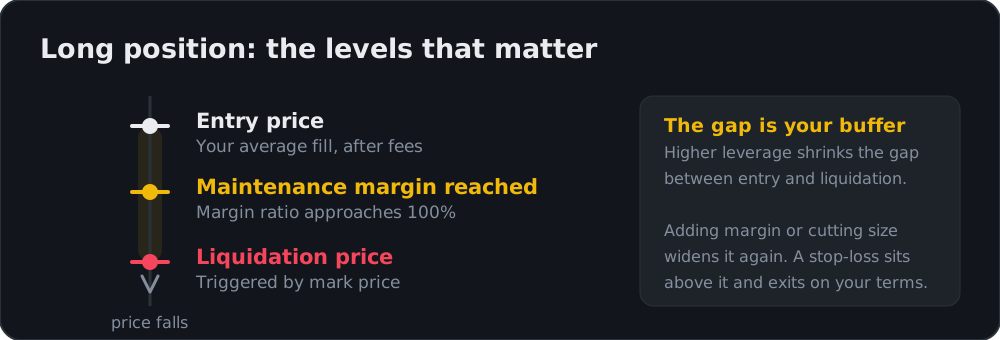
Your position is liquidated when its margin ratio reaches 100% — the point where margin balance no longer covers the maintenance margin requirement. The liquidation price is simply the price at which that happens, and it is evaluated against mark price, not the last traded price.
Mark price is the one that matters
Binance uses a mark price derived from a wider index rather than the last trade on a single contract. That is deliberate: it stops a brief wick on one venue from liquidating positions that the broader market never moved against.
The practical consequence is that the chart price you are watching is not the trigger. A candle can print through your liquidation level on the last-price chart without liquidating you, and — less often — mark price can reach the level while the last price looks fine. Switch the chart to mark price when a position is close to its liquidation level.
What sets the distance
Four inputs decide where the level sits:
| Input | Effect on the buffer |
|---|---|
| Margin allocated | More margin pushes the level further away |
| Leverage | Higher leverage pulls it closer to entry |
| Maintenance margin rate | Rises with position size, pulling the level closer |
| Isolated or cross | Isolated risks only the assigned margin; cross can draw on the wider balance |
A worked example
Take 500 USDT of margin at 10× on a long. Notional is 5,000 USDT.
The entire margin is consumed by roughly a 10% adverse move, because a 10% move on 5,000 USDT of notional is 500 USDT. Liquidation therefore arrives before a 10% drop — the maintenance margin requirement and fees are deducted first, so the level sits somewhat above where a naive calculation would put it.
Halve the leverage to 5× with the same 500 USDT of margin and notional falls to 2,500 USDT. Now a 10% move costs 250 USDT rather than 500, and the liquidation level moves roughly twice as far from entry.
Leverage does not change your risk per point of price. It changes how many points you can survive.
Isolated against cross
- Isolated: the position has its own margin. Liquidation destroys that allocation and stops there. The level is predictable and easy to reason about.
- Cross: the futures balance backs the position. The level sits further away because more funds are available, but a liquidation can reach into balance you were holding for other positions.
Isolated is generally the clearer choice while you are learning, precisely because the worst case is bounded and visible up front.
The liquidation fee makes it the worst outcome
Liquidation is not just a stop that fires at a bad price. A clearing fee of roughly 1.25% of position value is charged on top, which on a 5,000 USDT position is around 62 USDT — far more than the few USDT a normal round trip costs. Full breakdown in Binance futures fees.
This is the strongest practical argument for a stop-loss. A stop exits at a price you chose and pays ordinary trading fees. Liquidation exits at the platform's price and adds the clearing fee.
Three ways to widen the buffer
- Add margin. Directly increases margin balance and pushes the level away. Works, but commits more capital to a position that is already moving against you.
- Reduce position size. Cutting notional lowers the maintenance requirement and can drop you into a gentler bracket — see Binance leverage tiers.
- Use lower leverage from the start. The only one of the three that costs nothing and does not require you to react under pressure.
Watch the ratio, not the price
The liquidation price shown on the ticket is an estimate that moves as funding accrues, fees are charged and margin changes. The number that reflects your actual state in real time is the margin ratio — see Binance margin ratio.
Funding payments quietly erode margin on a position held through several settlement periods; funding rates explains the mechanics.
Related reading
- Contract mechanics: Binance futures guide
- Sizing and risk limits: Binance futures risk
- Exiting without reversing: reduce-only orders
⚠️ Futures are high-risk derivatives and can consume all assigned margin quickly. Figures checked August 2026; confirm live values in your account. Not investment advice.