
Futures
Binance Margin Ratio: The Number That Decides When You Are Liquidated
Margin ratio compares your maintenance requirement against your margin balance. At 100% the position is liquidated — and unrealised losses and funding both push it up.
Margin ratio is the single number that tells you how close a futures position is to being liquidated. It compares what the platform requires you to keep against what you actually have:
Margin ratio = maintenance margin ÷ margin balance
When it reaches 100%, the position is liquidated. Every other number on the futures screen is context; this one is the trigger.
The two components
Maintenance margin is the minimum equity the platform requires you to hold against the position. It is a percentage of notional value, and the percentage itself rises as the position gets larger — the bracket system covered in Binance leverage tiers.
Margin balance is what you actually have backing the position: the margin allocated, plus or minus unrealised profit and loss, minus fees and funding already charged.
The important asymmetry is that the numerator moves with position size, while the denominator moves with price, fees and funding in real time.
Why it rises when nothing looks like it changed
Three things push the ratio up without any action from you:
- Unrealised loss. This subtracts directly from margin balance. Price moving against you shrinks the denominator, so the ratio climbs.
- Funding payments. On a perpetual held through settlement, funding is deducted from margin balance. A position on the wrong side of persistent funding bleeds toward liquidation even in a flat market — see funding rates.
- Adding to the position. More notional means a larger maintenance requirement, and can push you into a bracket with a higher maintenance rate, raising the numerator twice over.
That third one surprises people. Averaging down adds margin and adds requirement, and if it crosses a bracket boundary the requirement can grow faster than the margin you just added.
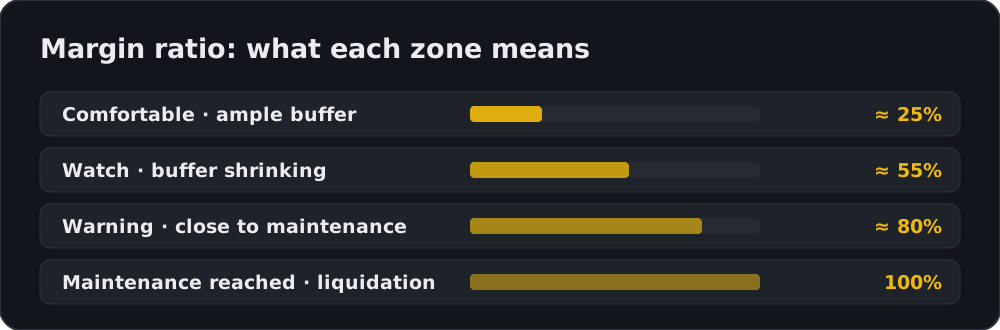
Reading the zones
| Ratio | What it means | Reasonable response |
|---|---|---|
| Low | Ample buffer | Normal management |
| Rising through the middle | Buffer thinning | Review the thesis; plan an exit |
| High, near maintenance | Little room left | Reduce size or add margin deliberately |
| 100% | Maintenance reached | Liquidated, plus the clearing fee |
There is no universal "safe" number, because the right level depends on the volatility of what you are trading and how much of the account the position represents. What is universal is the direction of travel: a ratio that has been climbing steadily is telling you something the price chart may not be.
Isolated against cross
Under isolated margin, the ratio is calculated against the margin assigned to that position alone. It moves fast, and liquidation is contained to that allocation.
Under cross margin, the whole futures balance backs the position. The ratio moves more slowly and sits lower for the same price move — which reads as safer but means a liquidation can consume funds you were holding for other positions. One bad position under cross margin can take the rest with it.
Bringing it down
Only two things lower the ratio, and they act on opposite sides of the fraction:
- Add margin — increases the denominator. Fast, but commits more capital to a losing position.
- Reduce position size — decreases the numerator, and may move you into a bracket with a lower maintenance rate, which reduces it further. Use reduce-only orders so a partial close cannot accidentally open a position on the other side.
Adding margin buys room without reducing exposure. Cutting size reduces both. Under real pressure, cutting size is usually the more honest response.
Check it against the liquidation price, not instead of it
The estimated liquidation price on the order ticket is derived from the same inputs, but it is a snapshot. It drifts as funding accrues and fees are charged. The ratio updates continuously, which makes it the better thing to watch on a position you are actively managing — and the liquidation price the better thing to check before you enter. See Binance liquidation price.
Related reading
- Contract mechanics and margin modes: Binance futures guide
- Position sizing: Binance futures risk
- Reading profit and loss correctly: PnL and ROE
- What liquidation costs: Binance futures fees
⚠️ Futures are high-risk derivatives. Formulas and thresholds vary by contract and account; confirm live values in your account. Not investment advice.